Verre Églomisé · April 2026 · 7 min read
Verre Églomisé: The Art of Reverse-Gilded Glass
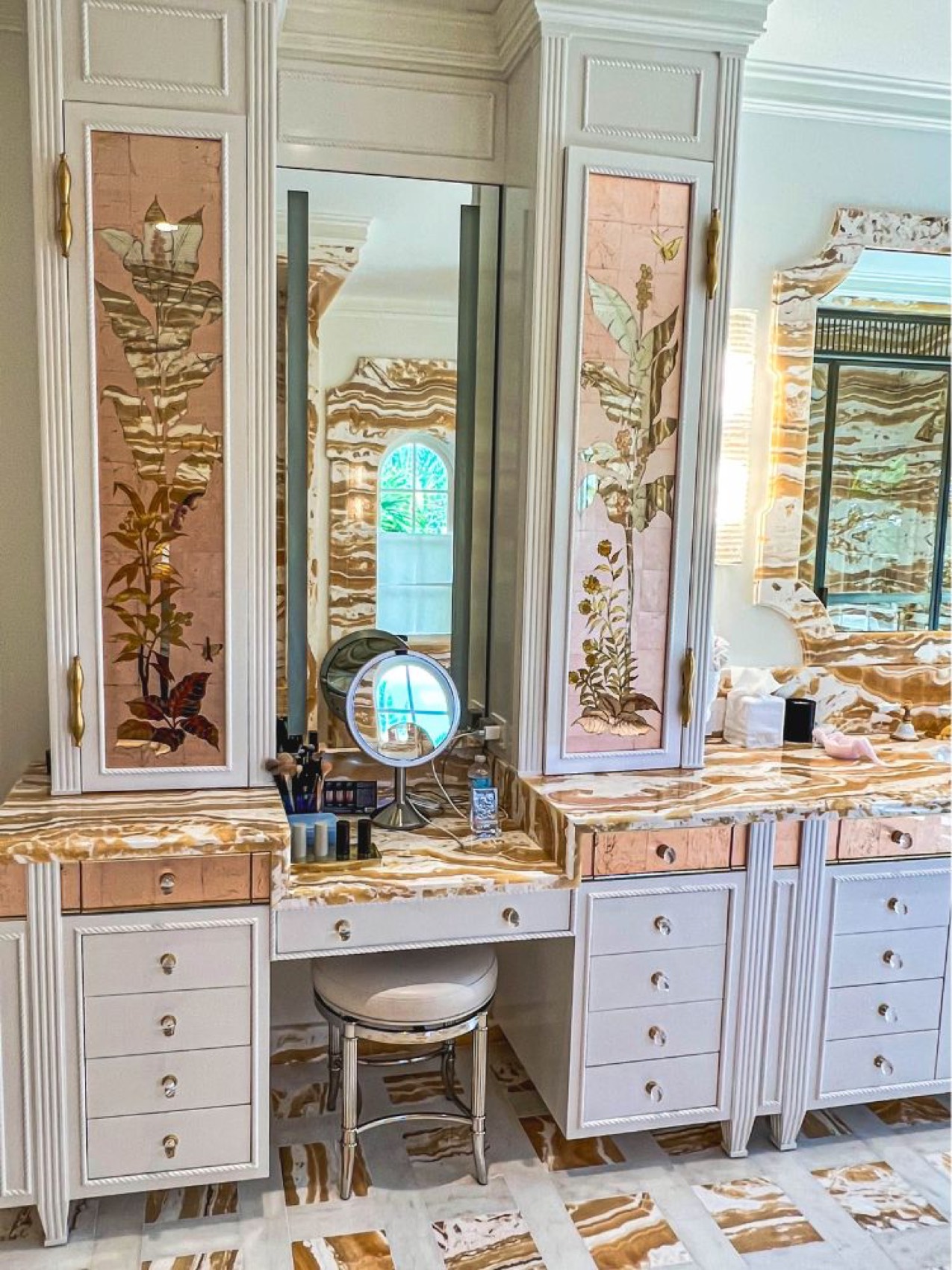
Some materials reflect light. Verre églomisé seems to hold it. Stand before a panel of reverse-gilded glass and the gold appears to float just beneath the surface, deep and luminous, shifting as you move past it. It is one of the most beautiful effects in all of the decorative arts, and one of the rarest, because almost no one still practices it at the level a fine interior demands.
The name honours Jean-Baptiste Glomy, an eighteenth-century French framer and gilder who popularised the technique, though the practice of gilding behind glass is far older, reaching back to the Romans and flourishing in medieval and Renaissance workshops. The principle is deceptively simple. Gold or metal leaf is applied to the reverse side of a sheet of glass, and the glass itself becomes the protective, light-giving surface. What you see is the gold as the glass sees it, flawless and untouched, sealed forever behind a clear pane.
Working in reverse
What makes verre églomisé so demanding is that the entire image must be conceived and executed backwards. The artist works on the rear of the glass, building the design from the front layer inward. The first marks made are the ones that will sit closest to the viewer in the finished piece, which means every detail, every line and shadow, must be planned in reverse order and reverse orientation. There is little room for correction. A misjudged stroke cannot simply be painted over, because it already sits in front of everything that follows.
The leaf is laid onto the glass over a delicate water size, then burnished through the back so that it adheres as a perfect, mirror-bright film. Where the artist wants pattern or imagery, the leaf is hand-tooled, scratched and incised with fine points to draw the design directly into the gold, allowing a backing colour to show through the lines. Painting, antiquing and additional leaf in gold, silver or palladium build the composition in layers, each one sealed by the next. Finally the back is protected, and the piece is turned to reveal the front for the first time. That moment, when the reversed labour resolves into a luminous image, is one of the quiet thrills of the craft.
”What you see is the gold as the glass sees it, flawless and untouched, sealed forever behind a clear pane.
A material of light
Because the gold sits behind glass, verre églomisé has a clarity and a depth that ordinary gilding cannot match. Direct gilding on a wall or moulding is matte or softly reflective. Gilding behind glass is brilliant and liquid, and it changes constantly with the light in the room. In the morning it can read as cool and silvery, in candlelight as deep and amber. This responsiveness is exactly why designers prize it for the most considered moments in a home.
It appears as luminous wall panels and feature walls, as inset doors and cabinetry fronts that turn ordinary joinery into something that glows, as splashbacks and table tops, and as the most exquisite mirror, where the antiqued silvering itself becomes the decoration. In a dressing room or a bar, a powder room or an entry, a single panel of églomisé can carry the entire mood of the space.
Why it is so rare
Verre églomisé survives at the margins of the decorative arts because it asks for a combination of skills that rarely sit in one pair of hands. The artist must be a gilder, a glass painter and a draughtsman, comfortable working in reverse and patient enough to accept that the work cannot be hurried or undone. Glass is unforgiving. Leaf is temperamental. And the scale of architectural panels adds the further challenge of consistency across a large surface. There are no shortcuts and no machines that produce the same result. Each panel is made by hand, one at a time.
That rarity is precisely what makes it meaningful in a luxury interior. A reverse-gilded panel is not a finish that can be specified from a catalogue and ordered by the metre. It is commissioned, designed for its specific wall and its specific light, and made by an artist who understands both the chemistry of the materials and the composition of the room. The result is a surface with genuine provenance, an object as much as a finish.
Commissioning a panel
A verre églomisé commission usually begins with the conversation a designer and artist have about light and intention. Where will the panel sit, and what should it do for the room. Should the gold read warm or cool, the pattern restrained or expressive, the antiquing fresh or aged. Hand-made samples follow, testing leaf, tooling and colour at scale, so that nothing is left to chance. Only then is the final glass worked, in studio conditions where dust and humidity can be controlled, before being installed with the care a piece of fine art deserves.
In an age of fast, replaceable surfaces, verre églomisé is a deliberate counterpoint. It is slow, it is singular, and it carries the unmistakable depth of something made entirely by hand. For the right wall, in the right light, nothing else comes close.
Kim DelaneyDelaney Fine Finishes
All essays
Begin a Custom Project
Commission a finish of your own.
For decorative finishes, murals, gilding or custom shell pieces, we welcome your inquiry.