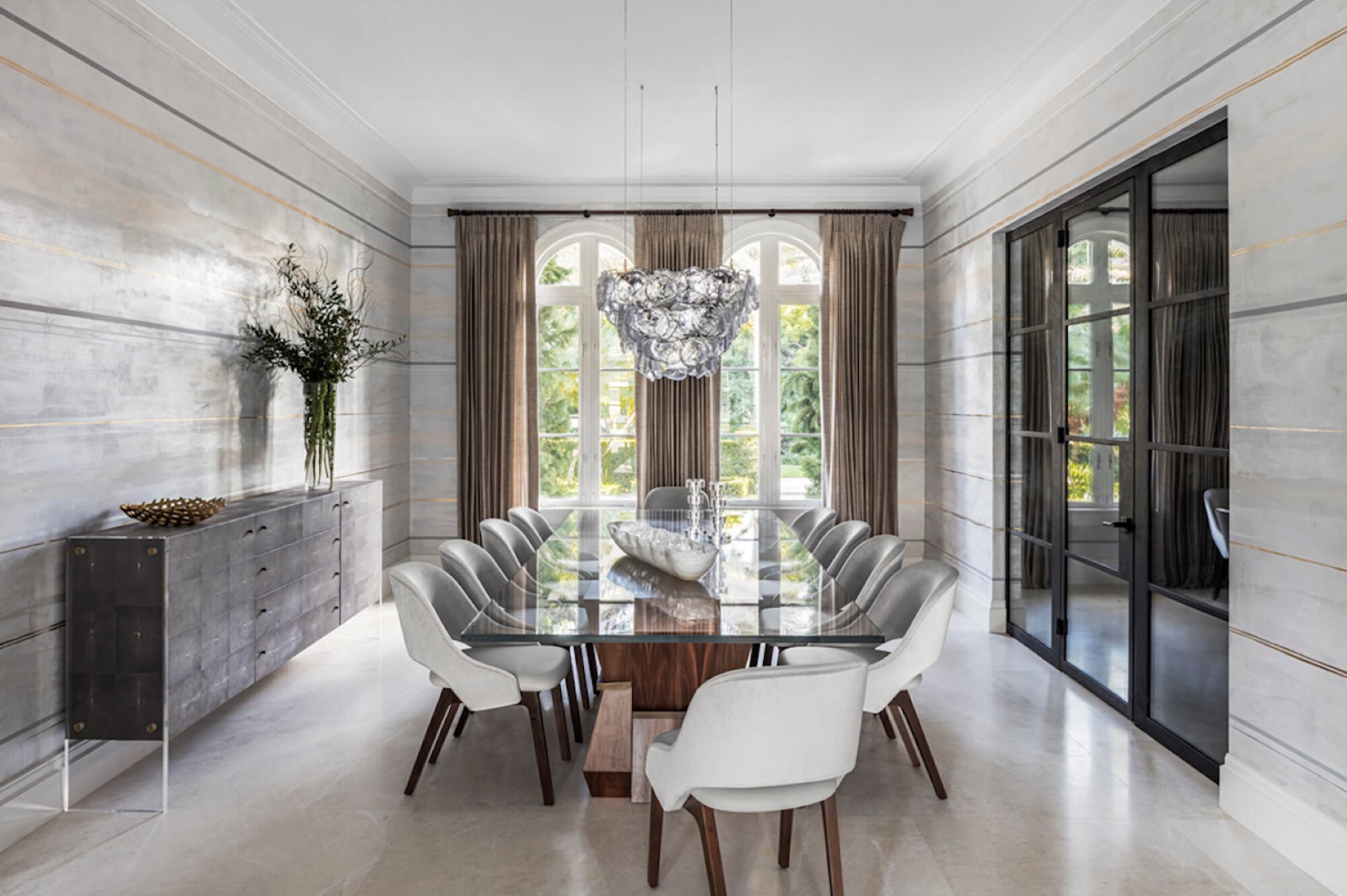
There is a particular kind of luxury that announces nothing. It does not glitter or insist. It simply holds the light a little differently than the wall beside it, and the eye keeps returning to it without quite knowing why. That is the quiet power of Venetian plaster, a finish so old that it predates almost everything else in the modern decorative vocabulary, and so refined that it still feels entirely contemporary in a Miami penthouse or a Palm Beach estate.
Venetian plaster, known in its homeland as stucco veneziano or marmorino, was perfected by the artisans of Renaissance Venice. Working in a city built on water, where heavy stone was impractical and damp was a constant adversary, they learned to grind marble and limestone into a fine putty, tint it with natural pigment, and apply it in successive thin coats. Burnished by hand, the surface took on the depth and movement of polished stone without any of its weight. Centuries later, the technique survives almost unchanged, because nothing has improved upon it.
What it actually is
True Venetian plaster is not a paint effect or a printed texture. It is a material, slaked lime and finely milled marble dust, mixed and tinted by hand for each commission. The lime gives it breathability and a soft inner luminosity. The marble gives it the faint crystalline sparkle that catches the light at certain angles. Because pigment is added to the body of the plaster rather than painted onto the surface, the colour lives inside the wall, not on top of it. This is the source of its remarkable depth. You are not looking at a wall that has been coloured. You are looking into a surface that is coloured all the way through.
The result can be tuned across a wide range. At one end, a soft, chalky matte that feels like aged stucco in a Tuscan villa. At the other, a high-burnished finish polished to a marble-like sheen that reflects a room in soft, broken light. Between those poles lie countless variations of colour, sheen and movement, and no two walls are ever identical.
A finish made by hand, in layers
The beauty of Venetian plaster is inseparable from the way it is made. The work begins with a perfectly prepared substrate, because lime plaster is honest and will reveal any flaw beneath it. The first coats are applied with a steel trowel in short, overlapping strokes, each one catching and dragging the material in a slightly different direction. This is what creates the subtle cloud-like movement that distinguishes a hand-troweled wall from any factory product.
As the coats build, the artisan reads the surface constantly, adjusting pressure, angle and timing. Lime has a mind of its own, and it responds to humidity, temperature and the hour of the day. The final pass is the burnish, when the trowel is worked back over the cured surface to compress and polish it. On a high-sheen finish, this is also where a thin protective layer can be introduced and worked in, sealing the wall and deepening its glow. The whole process cannot be rushed. It is a conversation between hand, tool and material that unfolds over days.
”You are not looking at a wall that has been coloured. You are looking into a surface that is coloured all the way through.
Where it belongs
Designers reach for Venetian plaster when a room needs presence without pattern. It is extraordinary on a feature wall behind a bed or a fireplace, where its movement reads almost like still water. It transforms a powder room into a jewel box, the polished surface bouncing candlelight around the small space. On a ceiling, it can lend a sense of enclosure and warmth that paint never achieves. And in an entry or a stair hall, it greets a guest with a quiet, tactile richness that sets the tone for everything beyond.
It also has a practical elegance. A well-made lime plaster is durable, naturally resistant to mildew, and ages gracefully rather than wearing out. It can be repaired and re-burnished by a skilled hand, and it carries none of the plastic flatness of conventional paint. For a coastal interior, where humidity and light are both unforgiving, it is a genuinely intelligent choice as well as a beautiful one.
Why bespoke matters
There are pre-mixed products that borrow the name, and they have their place. But the Venetian plaster that belongs in a serious interior is sampled and tinted specifically for the room it will live in, against its stone, its woods, its light at different hours. The colour is built up from natural pigments until it sits exactly right, neither too cool nor too warm, and the degree of sheen is chosen to suit the architecture. This is decorative artistry, not a product selection. The wall becomes a one-of-a-kind surface that cannot be reordered, and that is precisely its value.
For all its history, Venetian plaster never feels like a costume. It belongs as easily to a clean, modern room as to a classical one, because it is fundamentally about material honesty and the play of light. In a culture saturated with surfaces that shout, a wall that simply glows is the rarest luxury of all.
Kim DelaneyDelaney Fine Finishes
All essays

Begin a Custom Project
Commission a finish of your own.
For decorative finishes, murals, gilding or bespoke surfaces, we welcome your inquiry.